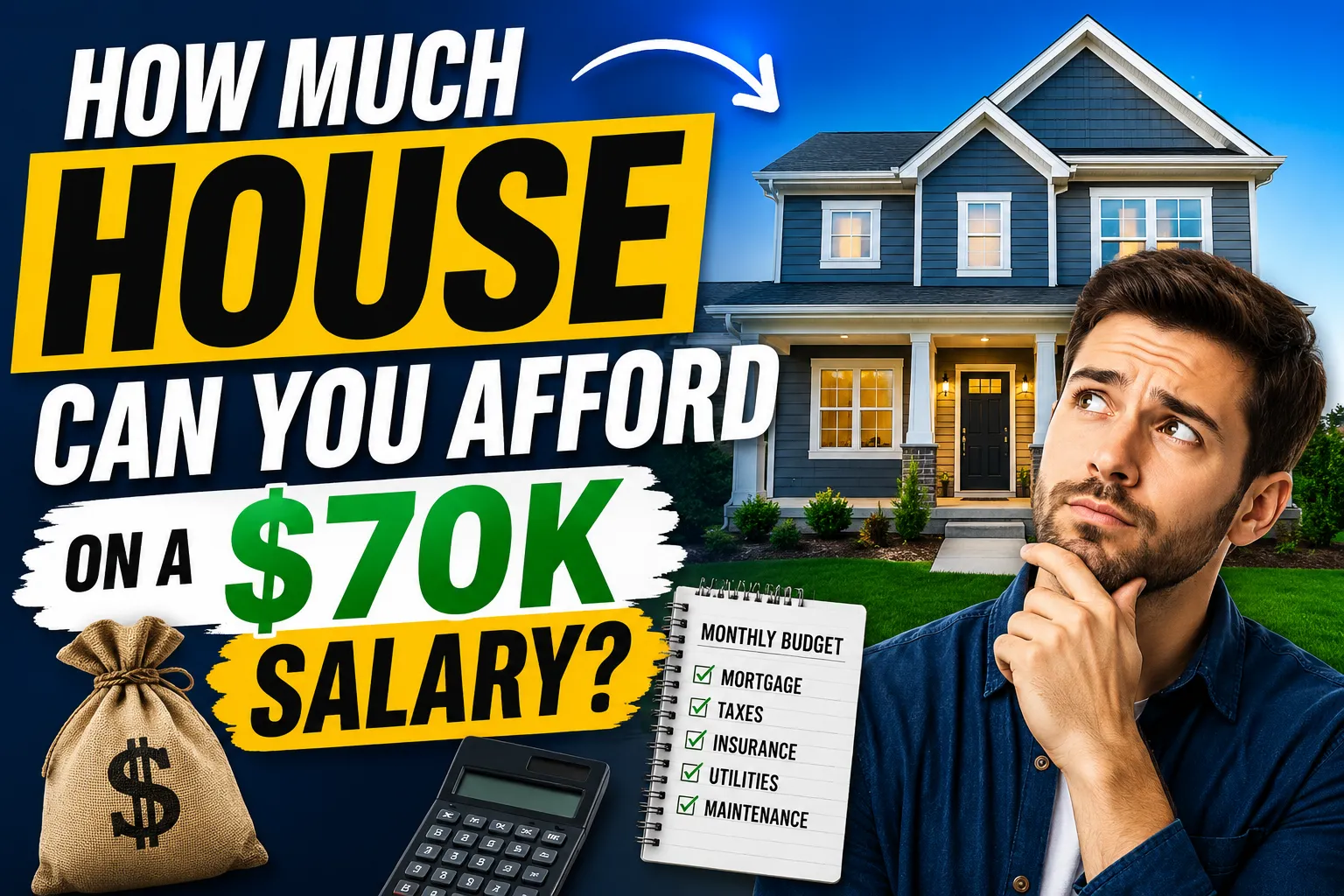
Buying a home on a $70,000 salary is completely possible in many parts of the United States, but the amount you can comfortably afford depends on more than just your income. Your debt, credit score, down payment, mortgage interest rate, property taxes, and even the city you live in can dramatically change your budget.
A lot of people assume they can simply multiply their salary by three or four and instantly know their home-buying budget. In reality, lenders look at your entire financial picture before approving a mortgage. The good news is that a $70K salary puts you in a solid position to buy a starter home or even a mid-range property in many states.
What Does a $70K Salary Mean Monthly?
If you earn $70,000 per year, your gross monthly income is around $5,833 before taxes. After taxes and deductions, most people take home somewhere between $4,200 and $4,800 per month depending on their state and benefits.
Mortgage lenders usually follow the “28/36 rule.” This means:
- No more than 28% of your monthly income should go toward housing expenses
- No more than 36% should go toward total debt payments including loans and credit cards
Using that formula, someone earning $70K annually should ideally spend around $1,600 to $2,000 per month on housing costs.
How Much House Can You Realistically Afford?
In today’s market, a person making $70,000 per year can typically afford a home priced between $250,000 and $350,000. The exact number depends on interest rates, debt levels, and your down payment.
Here’s a rough breakdown:
- With little debt and a strong credit score, you may qualify for homes around $350K
- With average debt and average credit, your budget may be closer to $280K–$320K
- With high debt or a small down payment, affordability may drop below $250K
Interest rates play a massive role here. Even a 1% increase in mortgage rates can significantly reduce how much home you can afford.
Your Down Payment Changes Everything
The size of your down payment directly impacts your monthly mortgage payment.
For example:
- 3% down on a $300K home = $9,000 upfront
- 10% down = $30,000 upfront
- 20% down = $60,000 upfront
A larger down payment reduces your monthly payment and can also eliminate private mortgage insurance (PMI), which saves hundreds of dollars every month.
Many first-time buyers earning $70K choose FHA loans or conventional loans with low down payment options to enter the market faster.
Credit Score Matters More Than People Think
Two people earning the exact same salary can qualify for very different homes because of their credit scores.
If your credit score is:
- 760+ → You’ll likely get the best mortgage rates
- 700–759 → Still very competitive
- 620–699 → Higher interest rates
- Below 620 → Loan approval becomes more difficult
A better interest rate can save you tens of thousands of dollars over the life of your mortgage.
Improving your credit score before applying for a home loan is one of the smartest financial moves you can make.
The City You Live In Makes a Huge Difference
A $70K salary stretches very differently depending on where you live.
In affordable states like Texas, Ohio, Indiana, or North Carolina, you may comfortably buy a large home with a backyard.
In expensive markets like California or New York, the same salary may only qualify you for a small condo or apartment.
That’s why many remote workers are relocating to lower-cost cities where their income goes much further.
Hidden Costs Most Buyers Forget
Many first-time homebuyers focus only on the mortgage payment and ignore additional costs.
Homeownership also includes:
- Property taxes
- Homeowners insurance
- HOA fees
- Maintenance and repairs
- Utilities
- Closing costs
- Moving expenses
These costs can easily add several hundred dollars per month to your budget.
A home may technically fit your lender’s approval amount but still feel financially stressful in real life.
Should You Spend the Maximum a Lender Approves?
Not always.
Banks may approve you for more than you’re personally comfortable paying. Just because you qualify for a large mortgage doesn’t mean you should take it.
A smart homeowner leaves room in their budget for:
- Emergency savings
- Vacations
- Investments
- Retirement contributions
- Unexpected repairs
- Lifestyle flexibility
Being “house poor” is one of the biggest mistakes many buyers make.
Best Mortgage Types for a $70K Salary
Several mortgage options work well for middle-income buyers.
Conventional Loan
Best for buyers with decent credit and stable income. Often offers lower long-term costs.
FHA Loan
Popular among first-time buyers because of low down payment requirements and easier credit qualifications.
VA Loan
Excellent option for eligible military members and veterans because it often requires zero down payment.
USDA Loan
Designed for rural and suburban areas. Some buyers qualify with zero down payment.
Tips to Afford a Better Home on a $70K Income
If you want to increase your home-buying power, a few strategies can help significantly.
Pay down credit card debt before applying for a mortgage. Lower debt improves your debt-to-income ratio.
Save for a larger down payment. Even an extra 5% down can reduce your monthly costs substantially.
Improve your credit score for better interest rates.
Consider buying in lower-cost suburbs instead of expensive downtown areas.
Shop multiple lenders instead of accepting the first mortgage offer you receive.
Many buyers save thousands simply by comparing loan offers.
Is Buying a House on a $70K Salary a Good Idea?
For many Americans, yes.
A $70,000 salary is enough to buy a comfortable home in a large number of U.S. cities, especially if you manage debt wisely and avoid overspending.
The key is buying a home that fits your lifestyle rather than chasing the maximum amount a lender approves.
Homeownership should improve your financial future, not create constant stress.
If you plan carefully, maintain a healthy emergency fund, and stay realistic about your budget, buying a home on a $70K salary can be one of the smartest long-term financial decisions you make.